
TVL, short for total value locked, is the value of all the assets users have deposited into a DeFi protocol's smart contracts. To calculate it, you take every token held in those contracts, multiply each balance by its current market price and add the results. DefiLlama, the most cited TVL tracker, defines it as the "total value locked inside a platform / protocol's own contracts by users" (DefiLlama).
TVL is the first number most people check when they size up a lending market, a DEX, a vault or a whole blockchain. It tells you how much capital sits in a protocol right now. It does not tell you how much of that capital is borrowed, how long it will stay or whether the protocol is safe. This guide explains how the number is built, what is left out, why it moves and how protocols measure the TVL a specific partner brought in.
What does TVL mean in crypto?
TVL measures the deposits a protocol holds at a point in time, priced in dollars. The assets can be anything a smart contract accepts: ETH and other native coins, stablecoins such as USDC, liquid staking tokens, LP tokens or tokenized treasuries.
Where the deposits come from depends on the type of protocol:
- Lending markets: assets users supply to earn interest or post as collateral.
- Decentralized exchanges: tokens liquidity providers deposit into trading pools.
- Vaults and yield products: assets pooled into a strategy that a curator or a smart contract manages.
- Bridges and chains: assets locked on one side to mint a representation on the other, and the sum of all protocol TVL on a network.

A bank's total deposits are a fair comparison. TVL shows how much money users have trusted to a protocol, and it moves every time they deposit, withdraw or the price of what they deposited changes.
How is TVL calculated?
The formula has three steps:
- List every token held in the protocol's contracts.
- Multiply the balance of each token by its current price in US dollars.
- Add the values together.
TVL = sum of (token balance × token price)
Here is an illustrative example for a small lending market. The balances and prices are made up to show the math.
| Asset | Balance in the contracts | Price (USD) | Value (USD) |
|---|---|---|---|
| ETH | 1,000 | 3,000 | 3,000,000 |
| USDC | 2,000,000 | 1 | 2,000,000 |
| wBTC | 20 | 100,000 | 2,000,000 |
| TVL | 7,000,000 |
Trackers read the balances directly from the blockchain and pull prices from market data, so anyone can check the number. Each protocol on DefiLlama has an open-source adapter that defines which contracts and tokens count toward its TVL (DefiLlama).
What counts as TVL, and what does not?
The formula is simple. The judgment sits in deciding which balances belong in it. DefiLlama splits deposits into a default TVL figure and optional filters, so readers can choose what to include (DefiLlama):
| Category | What it covers | In default TVL? |
|---|---|---|
| Core deposits | Assets users lock in the protocol's own contracts | Yes |
| Staking | Deposits of the platform's own token | Separate filter |
| Pool 2 | Staked LP tokens where one side is the platform's governance token | Separate filter |
| Borrows | Deposits that have been borrowed from the platform | Separate filter |
| Vesting | Tokens that are not circulating or not issued yet | Separate filter |
| Offers | Funds approved for spending on a non-custodial platform but not deposited | Separate filter |
| Offchain assets | Bonds or fiat held in a bank account, such as the dollars behind a stablecoin | No |
| Assets locked in other protocols | Tokens a protocol issues that are then deposited elsewhere | No, they count for the later protocol |
| Native token staking | Staking that secures a network, such as ATOM on the Cosmos Hub | No |
Two choices in that table change the number a lot. Excluding borrows avoids counting the same dollar twice when a user deposits, borrows and deposits again. Counting assets only in the protocol where they finally sit avoids adding the same deposit to two protocols at once.
DefiLlama also removes what it calls unproductive assets: pools with a few providers and no trading, lending pools with lenders and no borrowers, deposits made only to farm points, and wrapped assets without provable backing (DefiLlama).
Why does TVL go up or down?
TVL changes for two reasons, and it helps to separate them.
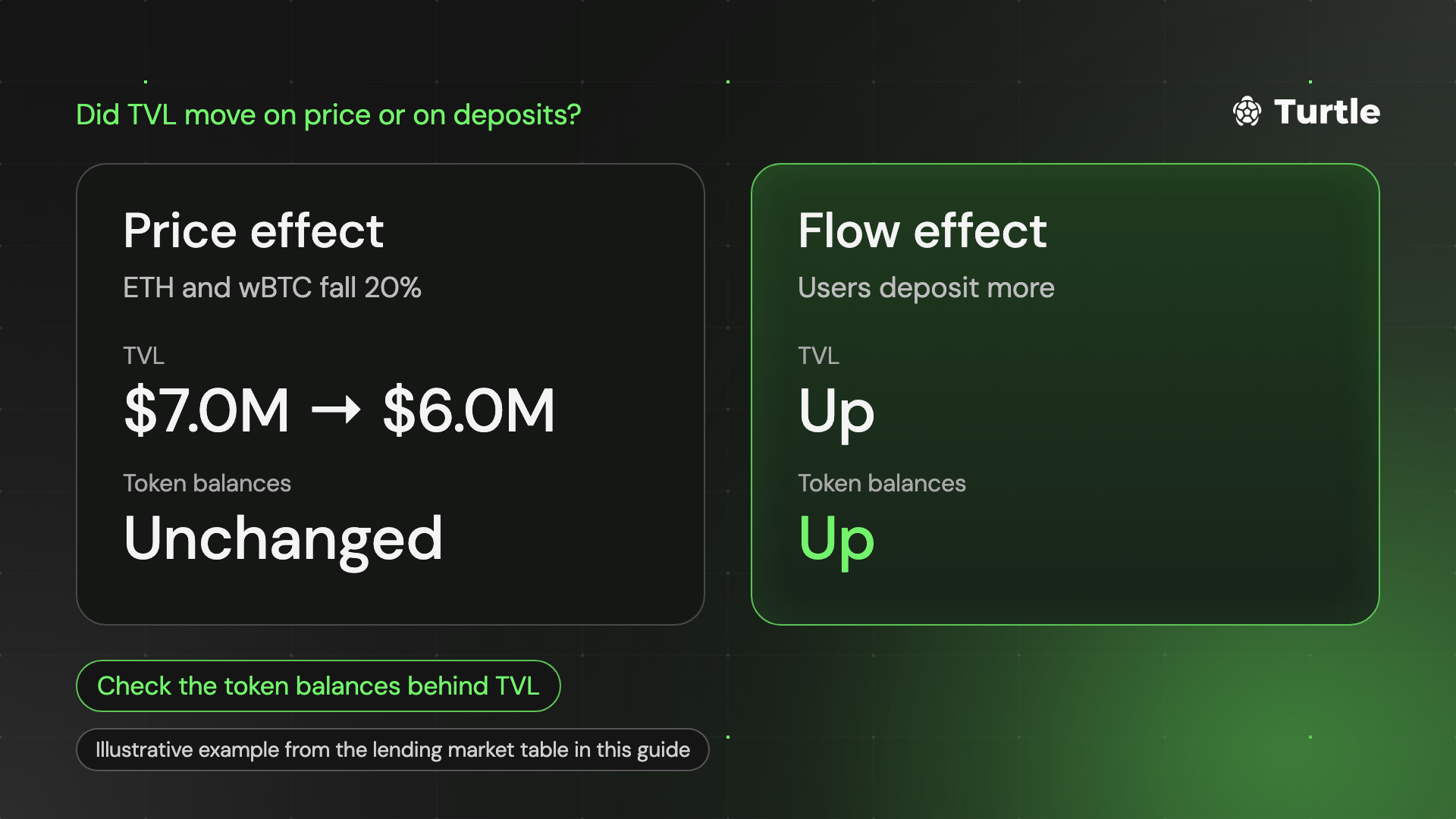
Price changes. If the price of a deposited token moves, TVL moves with it, even when no one deposits or withdraws. In the example above, a 20% fall in ETH and wBTC takes TVL from $7.0M to $6.0M with the same balances.
Flows. Users deposit when a protocol offers yield, new features or incentives, and withdraw when yields fall, risks rise or a better offer appears elsewhere.
To see which one drove a change, compare TVL with the token balances behind it. A rise in TVL with flat balances is a price effect. A rise in balances is new capital.
Incentives are the most common driver of flows, and the least stable. Capital that arrives only for rewards tends to leave when the rewards end, a pattern known as mercenary capital.
Split a TVL change into price and flows by checking the token balances.
Why does TVL matter?
Different readers use TVL for different decisions.
- Depositors read TVL as a proxy for liquidity depth. A deep pool makes it easier to enter and exit a position at a fair price, and many depositors avoid putting a large share of their capital into a small pool.
- Protocols and asset issuers use TVL to show traction to users, partners and investors, and to judge whether an incentive program worked. The cost of a program is often compared with the TVL it added, as in Turtle's cost-per-TVL benchmarks.
- Chains report total TVL across their protocols as a signal of ecosystem activity.
What are the limits of TVL?
TVL is a snapshot of deposits. Treat it as a starting point and check these gaps before you rely on it.
- It follows prices. A bull market inflates TVL across the board, and a sell-off shrinks it.
- It can count the same capital more than once. Loops, wrapped tokens and liquid staking tokens deposited in several layers can inflate totals when a tracker includes borrows or nested assets.
- It says nothing about stickiness. A protocol can hold a high TVL that leaves the week its incentives end.
- It is concentrated. A few large wallets can make up most of a protocol's TVL, and their exit moves the number at once.
- It is not a safety score. Protocols with large TVL have been exploited. A high number shows how much users deposited, and the risks of the contracts, the curator and the assets still need their own review.
What is the market cap to TVL ratio?
The market cap to TVL ratio compares what the market values a protocol's token at with the deposits the protocol holds.
Mcap/TVL = token market cap ÷ protocol TVL
An illustrative case: a token with a $50M market cap and a protocol holding $100M in TVL has a ratio of 0.5. Some analysts read a ratio below 1 as the token being cheap relative to the capital the protocol attracts. The ratio is a rough screen. It ignores revenue, how much of the TVL is incentivized and whether the token captures any value from the protocol.
How do protocols measure the TVL a partner brought in?
Total TVL shows everything in a protocol. A protocol paying for liquidity usually wants a narrower number: the TVL that came from a given campaign, distributor or partner.
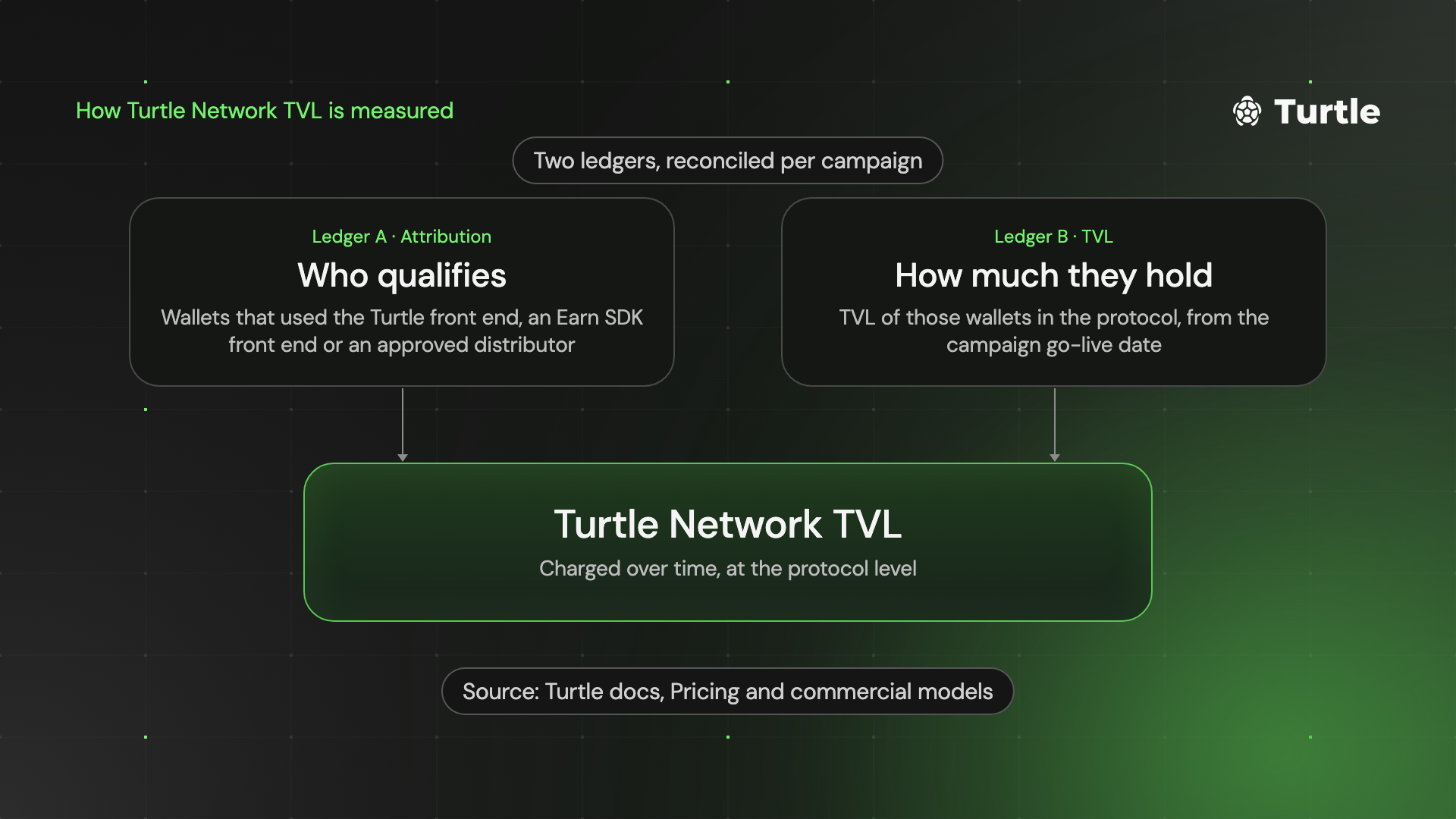
Turtle measures this as Turtle Network TVL. It runs two ledgers in parallel. An attribution ledger records which wallets interacted with the Turtle front end, a front end built on the Turtle Earn SDK or an approved distributor front end, and adds the qualifying wallets to a campaign-specific list. A TVL ledger tracks the TVL of those wallets in the protocol from the campaign's go-live date. Reconciling the two gives the TVL Turtle can show it brought in (Turtle docs).
Turtle Network TVL reconciles who qualifies with how much they hold.
Turtle charges liquidity campaigns on that TVL over time, measured at the protocol level, and leaves deposit and withdrawal flows out of the calculation. According to Turtle's docs, this "removes manipulation risk, looping behavior, and cross-interface complexity" (Turtle docs). LPs pay nothing to Turtle.
If you run a protocol and want to grow TVL from depositors who stay, see how Turtle runs liquidity campaigns at turtle.xyz/liquidity.
FAQ
Is a high TVL good?
A high TVL means users have deposited a lot of capital, which usually brings deeper liquidity. It does not show whether the capital is incentivized, borrowed or concentrated in a few wallets, and it is not a measure of safety. Check how the TVL is made up before reading it as a quality signal.
Where can I check a protocol's TVL?
DefiLlama tracks TVL for protocols and chains and publishes its methodology and adapters. Many protocols also show their own TVL in their app. When the two differ, the difference usually comes from what each one counts, such as borrows or the protocol's own token.
Does TVL include borrowed funds?
It depends on the tracker. DefiLlama keeps borrows out of its default TVL and shows them as a separate filter, which avoids counting the same deposit twice in lending markets.
What is the difference between TVL and market cap?
Market cap is the value of a token's circulating supply. TVL is the value of the deposits a protocol holds, in any token. A protocol can have a large TVL and a small token market cap, or no token at all.
Can TVL be manipulated?
Yes. Looping deposits, short-term incentive farming and wrapped assets without backing can all inflate TVL. DefiLlama excludes some of these unproductive assets, and protocols that pay for liquidity often measure TVL over time to limit gaming.
What is attributed TVL?
Attributed TVL is the share of a protocol's TVL linked to a specific source, such as a campaign, a distributor or a partner front end. Turtle calls its version Turtle Network TVL and uses it to price liquidity campaigns.